
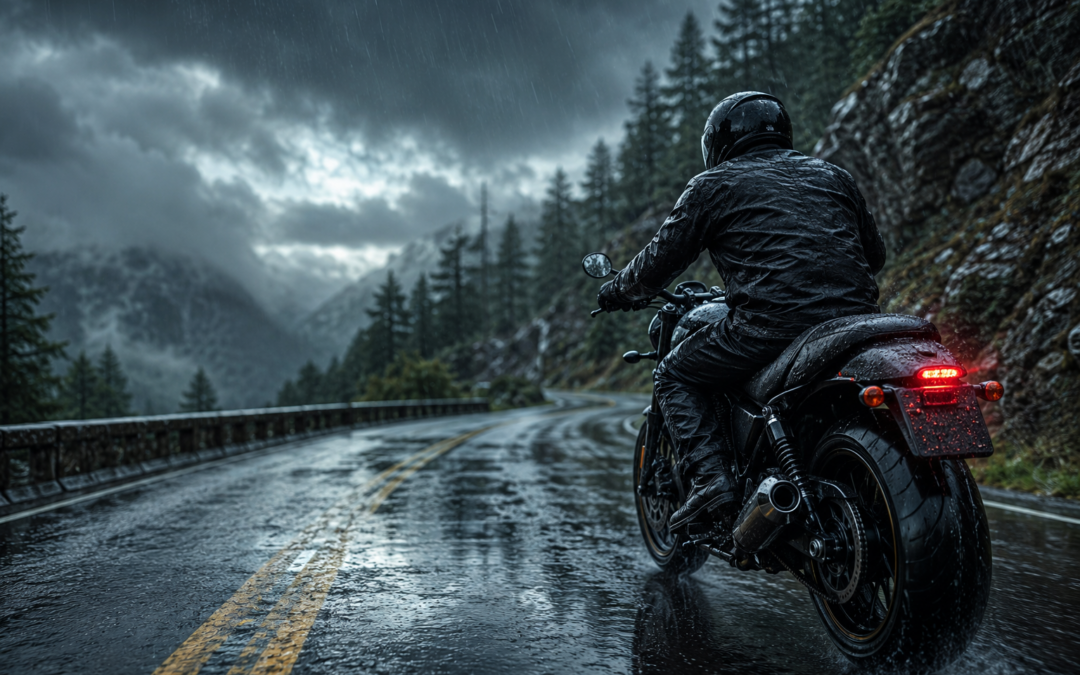
Few things make motorcyclists more nervous than seeing dark storm clouds gathering ahead. While many riders simply pull over and wait it out, the truth is that most long-distance riders eventually find themselves riding through rain. Whether you’re commuting to work, touring across the country, or caught unexpectedly in a summer thunderstorm, knowing how to ride safely in wet conditions can mean the difference between arriving home safely and becoming another crash statistic.
The good news is that motorcycles can be ridden safely in the rain.
The bad news is that rain changes everything.
Your traction decreases, visibility suffers, braking distances increase, road hazards become far more dangerous, and other drivers become even less aware of motorcycles. Understanding these changes—and adjusting your riding accordingly—is the key to staying safe.
The Biggest Myth About Riding in the Rain
Many riders believe that rain makes roads extremely slippery from start to finish.
That isn’t exactly true.
Ironically, the most dangerous time is often the first 15 to 30 minutes after rain begins.
Oil, coolant, fuel residue, rubber particles, dirt, and dust accumulate on the pavement during dry weather. When the first rain begins, these contaminants mix with the water and create an incredibly slick surface—almost like soap.
Once the rain continues long enough to wash these contaminants away, traction generally improves, although it never returns to dry-road levels.
If you’re caught in the first few minutes of rainfall, assume the road is significantly more slippery than it will be an hour later.
Slow Down—but Don’t Crawl
One of the most common mistakes riders make is slowing down excessively.
Yes, you should reduce your speed.
But traveling dramatically slower than surrounding traffic can create another hazard.
Instead:
- Reduce your speed smoothly.
- Avoid sudden acceleration.
- Keep a larger cushion around your motorcycle.
- Let impatient drivers pass.
- Ride at a speed that allows smooth, predictable control.
Remember, your objective isn’t to ride fast.
Your objective is to ride smoothly.
Smooth riders stay upright.
Jerky riders crash.
Increase Your Following Distance
In dry conditions, many riders use a two- or three-second following distance.
In the rain, double it.
Aim for at least four to six seconds, and even more if visibility is poor.
Why?
Because every vehicle ahead of you is throwing water onto your face shield while also requiring longer stopping distances.
More space equals more reaction time.
Be Gentle With Every Control
Motorcycles dislike abrupt inputs in wet conditions.
Every control should be treated as though you’re balancing a glass of water on your gas tank.
Throttle
Roll on gently.
Abrupt throttle application can spin the rear tire, particularly on motorcycles with high horsepower.
Brakes
Modern ABS is a tremendous safety feature, but physics still applies.
Brake earlier.
Brake progressively.
Avoid grabbing a handful of front brake.
The front tire still provides most of your stopping power—but traction is reduced.
Steering
Avoid sudden steering corrections.
Countersteer gently.
Smooth inputs allow the tires to maintain traction.
Look Far Ahead
Rain reduces visibility for everyone.
Drivers are looking through wet windshields.
You are looking through a wet face shield.
Look farther ahead than usual.
This gives you more time to:
- Avoid puddles
- Spot stopped traffic
- Anticipate lane changes
- See road debris
- Plan smooth lines through curves
Painted Lines Can Become Ice
One of the biggest surprises for new riders is how slippery painted road markings become.
Examples include:
- Crosswalks
- Lane stripes
- Stop bars
- Arrows
- Bicycle lane markings
Whenever possible:
Cross them upright.
Avoid braking while riding over them.
Avoid accelerating while riding over them.
Avoid leaning significantly while crossing them.
Watch Out for Metal Surfaces
Metal offers almost no traction when wet.
Be extremely cautious around:
- Railroad tracks
- Steel bridge grates
- Utility covers
- Manhole covers
- Construction plates
Whenever possible:
Cross them as upright as possible.
Never brake while crossing them.
Beware of Tar Snakes
Those black strips used to seal cracks in pavement—often called “tar snakes”—can become surprisingly slick in the rain.
If your motorcycle wiggles slightly while crossing them, don’t panic.
Stay loose on the handlebars.
Let the motorcycle move naturally.
Avoid sudden corrections.
Standing Water Can Hide Serious Hazards
Never assume a puddle is shallow.
Standing water may conceal:
- Deep potholes
- Broken pavement
- Debris
- Missing asphalt
- Loose gravel
If you can’t see through it, slow down and avoid it if possible.
Hydroplaning on a Motorcycle
Motorcycles are less likely to hydroplane than cars because of their narrower tires.
However, it absolutely can happen.
Hydroplaning becomes more likely when:
- Speed increases
- Tires are worn
- Water is deep
- Tire pressure is incorrect
If you feel hydroplaning:
Don’t panic.
Don’t slam on the brakes.
Reduce throttle gradually.
Keep the motorcycle pointed straight until traction returns.
Curves Require Extra Respect
Most rain-related motorcycle crashes occur because riders enter curves too fast.
Remember:
You have less traction than usual.
Reduce speed before entering the turn.
Maintain a steady throttle throughout the corner.
Avoid sudden braking while leaned over.
Use smooth, deliberate countersteering.
Choose the Best Lane Position
Many riders have heard that the center of the lane is dangerous because of oil.
Sometimes that’s true.
Sometimes it isn’t.
Look for the cleanest pavement.
In heavy rain:
The wheel tracks made by cars often offer the best drainage.
Avoid areas where water is pooling.
Always ride based on conditions—not rules.
Make Yourself Visible
Rain makes motorcycles almost disappear.
Improve your visibility by using:
- Bright riding gear
- Reflective materials
- Auxiliary driving lights
- High-quality headlight
- Clean visor
- Proper lane positioning
Assume drivers don’t see you.
Ride accordingly.
Keep Your Vision Clear
A fogged visor can become more dangerous than the rain itself.
Consider:
- Pinlock visor systems
- Anti-fog treatments
- Breath guards
- Slight visor opening when safe
- Clean visor before every ride
Never wipe your visor with a dirty glove.
You’ll simply smear road grime across it.
Good Tires Matter More Than Ever
Your tires are your only connection to the road.
Check:
- Tread depth
- Tire pressure
- Age of the tire
- Uneven wear
A tire that feels acceptable on dry pavement may perform poorly in wet conditions.
If you’re riding on worn tires, replace them before rainy season.
Wear Proper Rain Gear
Staying dry isn’t just about comfort.
Cold, wet riders become fatigued quickly and make poor decisions.
Quality rain gear should include:
- Waterproof jacket
- Waterproof pants
- Waterproof gloves
- Waterproof boots
- Neck gaiter
- Layers underneath for warmth
Modern laminated riding gear can make riding in moderate rain surprisingly comfortable.
Lightning Changes Everything
Rain alone is manageable.
Lightning is different.
If lightning becomes frequent:
Pull off safely.
Find shelter.
Wait it out.
No destination is worth becoming the tallest object on the highway.
Know When Not to Ride
Experience includes knowing your limits.
Consider stopping if:
- Visibility drops below safe levels.
- Heavy crosswinds accompany the storm.
- Roads begin flooding.
- Hail starts falling.
- You’re mentally exhausted.
- You no longer feel comfortable.
There is absolutely no shame in waiting out severe weather.
Professional riders do it all the time.
What If You’re Involved in a Crash?
Rain does not automatically mean a motorcycle rider caused the collision.
In fact, many wet-weather motorcycle crashes are caused by drivers who:
- Follow too closely.
- Fail to yield.
- Make unsafe lane changes.
- Turn left in front of motorcycles.
- Drive too fast for conditions.
- Lose control due to negligence.
Insurance companies often try to blame the weather instead of the negligent driver.
Weather may contribute to an accident, but it rarely excuses careless driving.
If you’ve been injured, preserve your riding gear, helmet, photographs, and motorcycle before repairs begin. These items can become important evidence when proving how the collision occurred.
Final Thoughts
I’ve ridden thousands of miles through every type of weather imaginable, including heavy mountain rain, sudden summer thunderstorms, and long-distance touring where avoiding the weather simply wasn’t an option. The truth is that rain doesn’t have to end your ride—but it does require a different mindset.
The riders who stay safe aren’t necessarily the fastest or the most experienced. They’re the ones who recognize changing conditions, adapt their riding style, and never let pride dictate their decisions.
Motorcycling has always involved managing risk. Riding in the rain simply requires a little more patience, a little more awareness, and a lot more smoothness.
Slow down. Stay relaxed. Look ahead. Ride your own ride.
You’ll likely discover that riding in the rain isn’t nearly as intimidating as you once thought—and you’ll arrive safely to enjoy the next sunny stretch of road.
About the Author
Norman Gregory Fernandez is a California motorcycle accident attorney, lifelong rider, and founder of The Law Office of Norman Gregory Fernandez & Associates. With nearly 30 years of experience representing injured motorcyclists, Norman combines real-world riding experience with decades of courtroom advocacy. Through the Biker Law Blog, he shares motorcycle safety tips, legal insights, and practical advice to help riders stay safe on every ride.
Visit:
- https://www.bikerlawblog.com
- https://www.thepersonalinjury.com
- Call: (800) 816-1529
“Ride smart. Ride within your limits. Make it home every time.”